Friday, 23 October 2015

The Lyte Jewel

The ‘Lyte Jewel’ is one of the best jewelery pieces in the British Museum. It is in fact an enamelled gold locket. The openwork cover, set with diamonds, bears the royal monogram 'IR’ (Latin, Iacobus Rex) for King James, the first Stuart king of England (r. 1603–1625, also James VI of Scotland, r. 1567–1625).


Inside the locket is James’ portrait on vellum by the great miniature painter Nicholas Hilliard (c. 1547–1619). The pendant pearl is a late-19th-century replacement of an original.


The 'jewel’ was presented by James to Thomas Lyte (1568–1638) of Lytes Cary, Somerset, in thanks for Lyte’s royal genealogy tracing James’ descent, through Banquo (whose murder is a key element in Shakespeare’s Macbeth), from Brutus, the mythical Trojan founder of Britain. This was a political message which James wished to promote at court in establishing his rule as king of Great Britain, and the genealogy was displayed in Whitehall Palace for all to see. You can find out more about the genealogy on the British Library’s websiteA portrait of Lyte, shown proudly wearing the jewel, was painted in 1611 and is now in the Museum of Somerset, Taunton.


James, the son of a Catholic, Mary Stuart, Queen of Scots, had succeeded to the throne of England in 1603. As a Protestant and the first Stuart monarch of England, he saw the political necessity to emphasise his ancient lineage not only through the Tudor line, but also through his Welsh ancestry back to the first king of the Britons. It is possible that Lyte, a relatively unknown member of the gentry, was encouraged by James’ advisers to produce the genealogical table, and to present it with full publicity at court, as if spontaneously from a loyal subject.
The jewel remained in the Lyte family for centuries until Baron Ferdinand Rothschild acquired it in 1882 for £2,835. He gave it prime position in his New Smoking Room at Waddesdon Manor from 1896. Within the context of a strongly continental collection, largely formed on the art markets of Frankfurt, Vienna and Paris, it had a special role as a document of British history and identity. On Baron Ferdinand’s death in 1898 it was acquired by the British Museum as part of the Waddesdon Bequest. The Bequest will be redisplayed in a new gallery at the Museum from 11 June 2015.
original post: http://britishmuseum.tumblr.com/post/120434323692/the-lyte-jewel

More information about collections and available items on sale in: movilla-jewellery.moonfruit.com

Tuesday, 13 October 2015

A four-year-old boy unearthed a rare 16th century gold pendant

Some months ago I came across with a story about a girl that found a german Nazi gold ingot in a lake in Austria. She was just diving and having fun on summer holidays. I was stunned that so many treasures might be still hidden and ready to be discovered and how many people dedicates their time to try to find a gem that potentially could change their lives. That's what happened 5 year ago to this boy and his father. So to say that here in uk there is a real fever of detectorist (as they wanted to be called) gathering in clubs, offering talks about their practise and even with normative and legal regulations in every constituency.
Here is the Story:
A four-year-old boy unearthed a rare 16th century gold pendant which could be worth millions of pounds on his first ever metal detecting trip. James Hyatt was using his grandfather's metal detector in a field when he literally struck gold.
article-1330198-0C191E90000005DC-386_634x663
His stunned father Jason, 34, dug down eight inches into the mud and unearthed a gold 16th century religious pendant which could have been owned by a member of the royal family.James, who was three at the time of the discovery, could now become a millionaire because his discovery has officially been declared as treasure trove and similar reliquaries have sold for £2.5 million.
His father, a web designer, from Billericay in Essex, said: 'My son is one of the luckiest people ever.'If we go to the doctors he'll put his hand down the side of the sofa and pull out a tenner, so this is just the sort of thing that happens to him.
Mr Hyatt, who lives with his wife Rebecca, added: 'The metal detector was bigger than James.'We got a couple of little buzzes, things like nails and coins and it wasn't long before we got a strong buzz and we dug it up.
'It was about eight inches down, we could see the metal glinting so we gently pulled it out and there it was.'We dug down down and I saw this bright, glistening. I couldn't believe it. I was in disbelief, I looked around and thought it was some kind of prank.
'The soil came away quite easily and I could see it was gold. It was about the size of a 50 pence piece but thicker, it was a little box and the lid was crushed down.
'I think James was too young to appreciate what was happening. I was shocked and quite excited and he picked up on that. He knew something special had happened.
'Dad was blown away, in 15 years doing it as a hobby he'd never found anything like it.'
When the tiny mud-caked pendant was cleaned up it was revealed to be a religious piece of jewellery believed to date from the early 1500s and, due to the quality of the piece, is thought to have been owned by a high ranking clergyman or a member of the royal family.
The square pendant appears to be engraved with Mary the mother of Jesus clutching a cross and the shrine on the front, and five bleeding hearts of Christ on the back.
Around the sides it is engraved with the names of Caspar, Melchior and Balthasar, the three kings who followed in the star to Bethlehem to witness Christ's birth.
Mr Hyatt contacted the Essex Finds liaison officer and the British Museum who look the locket in for further examination.
The tiny piece of jewellery, which measures 25 mm along the length, has undergone rigorous testing and has found to be medieval and made of up to 73 per cent gold.
The names of the three kings had been misspelled on the locket but the engraving was of a type popular in the 16th century.
A letter from the British Museum said: 'The back panel slides out to reveal a cavity, undoubtedly designed to contain a relic.
'Devotion to the wounds of Christ was one of the hallmarks of the late medieval piety. 


'The letters of the inscriptions are of a type of Lombardic script in use in the sixteenth century. The reliquary pendant is gold and dates from the first half of the sixteenth century.'

'They have classed it as high status which I believe means it probably belonged to someone high up in the church, or royalty.
'Maybe they dropped it when they were out hunting. I've been told it's an incredible piece.'
The locket is in the safe keeping of the British Museum and is to go before the Treasure Valuation Committee to discover how much it is worth.
article-1330198-0C191EAD000005DC-306_634x286
The British Museum and Southend Museum have both expressed an interest in buying the piece but until the valuation Mr Hyatt has no idea how much it is worth.
He said: 'I had heard about the jewel one, that had a big sapphire on the front of it, so it could be worth more than the one we found, there was an auction at Sotherby's last year when half of a locket sold for £38,000 - so I really don't know.
The locket, known as a reliquary, was used to contain supposed pieces of the crown of thorns Jesus wore at his crucifixion or a splinter of the cross he was killed on.
Plant material, which could be wood, was discovered inside the reliquary, and is being tested by scientists to discover what it is and how far back it dates.
In the 16th century reformists, like Martin Luther, opposed the use of relics as they suspected many were fake and so were destroyed, melted down and pulled apart, by the Calvinists.
Only three other reliquaries of this kind are known to have survived, including one called the Middleham Jewel, also found by a metal detector, which was sold at auction in 1986 for £1.3 million and later to the Yorkshire Museum for £2.5 million.
James's find was the subject of an inquest where it was deemed to be treasure trove so it can be sold on.
The proceeds from the sale will be split between the family and the landowner.
The find was made in Hockley, a small town near Southend, which has a church which dates back to the 12th century.
There is a also a 14ft high burial mound called Plumberow Mount which was excavated in 1913 and revealed a Roman coin and some Saxon pottery.
The exact location of where the precious locket was found is being kept top secret to protect it from unauthorised treasure hunters.
The landowner, who does not want to be identified, will be getting some of the proceeds of any future sale.
More information about collections and available items on sale in: movilla-jewellery.moonfruit.com

Sunday, 11 October 2015

Tea and coffee set designed by Archibald Knox for Liberty & Co

Lately I've been researching a little bit of design and artistic movements, and one of my favourites is the arts and crafts period. This Guy, Archibald Knox made amazing pieces and here is one of them, designed for Liberty & co department store with one of his brands, Tudric, in Pewter. 

But many others in that period hadn't have the same fortune. Brands like Osiris went bankrupt after a short period of trading and his owner committed suicide. Others ended up being absorbed by the giant WMF in Germany. And they also had amazing designs and same quality, but sometimes this is not enough. As in many other circumstances in life, blessings from the Fortune goddess make the difference. But this is another History... 

Today is Archibald Knox Chapter and his well deserved success. 

image
This elegant pewter tea and coffee set, decorated with a Celtic-inspired interlace pattern, was designed in 1903 by Archibald Knox (1864–1933), and was sold by the famous London department store Liberty & Co. Originally a pupil, and subsequently a teacher, at the School of Art in Douglas, Isle of Man, Knox designed for Liberty & Co. between the late 1890s and around 1909, partly while teaching at Kingston School of Art. He later returned to Douglas in order to teach and remained on the Isle of Man for the rest of his life.
Knox was a product of the Arts and Crafts movement, which not only championed the revival of lost ‘skills’, but also encouraged the strengthening of national identity. Living on the Isle of Man, Knox was well acquainted with the Celtic revival taking place in Ireland during the second half of 19th century. He visited Dublin in the 1890s to study archaeological discoveries such as the Ogham brooch, as well as the Book of Kells. The Isle of Man experienced a similar revival. During the late 19th and early 20th centuries, various societies were established to preserve the documentation of Celtic art on the island, the famous Manx stone crosses (covered in interlaced patterns) were documented, and efforts were made to preserve Manx Gaelic as a spoken language. It is impossible to know how important Knox felt these causes to be, but he was certainly influenced by Celtic art, both from Ireland and the Isle of Man. His designs were not copied directly from original Celtic art, but were a reinterpretation of Celtic motifs and designs, which he had been perfecting since childhood.
Knox’s designs were unique in that they combined Celtic interlace with an interpretation of the Art Nouveau ‘whiplash’ pattern, which had proved so popular in continental Europe. Knox was one of the few British designers to incorporate Art Nouveau into his designs, and was the main reason that Liberty & Co. goods sold successfully across Europe, as well as in Britain.
Although Knox produced the designs, the pewter wares were produced on an industrial scale by W H Haseler Ltd, jewellers and silversmiths of Birmingham, and retailed by Liberty & Co. in London. The store introduced a range of silver jewellery and plate made to Knox’s designs in 1899, naming it ‘Cymric’, followed by a pewter range in 1900, called ‘Tudric’, of which this coffee set is a part. These Gaelic-sounding (but meaningless) names were invented by Liberty & Co. as part of their advertising campaign, emphasising the ‘Celtic’ nature of Knox’s work and appealing to long-held Arts and Crafts notions of national heritage.

original information at: http://britishmuseum.tumblr.com/post/126336219342/tea-and-coffee-set-designed-by-archibald-knox-for

More information about collections and available items on sale in: movilla-jewellery.moonfruit.com

Friday, 2 October 2015

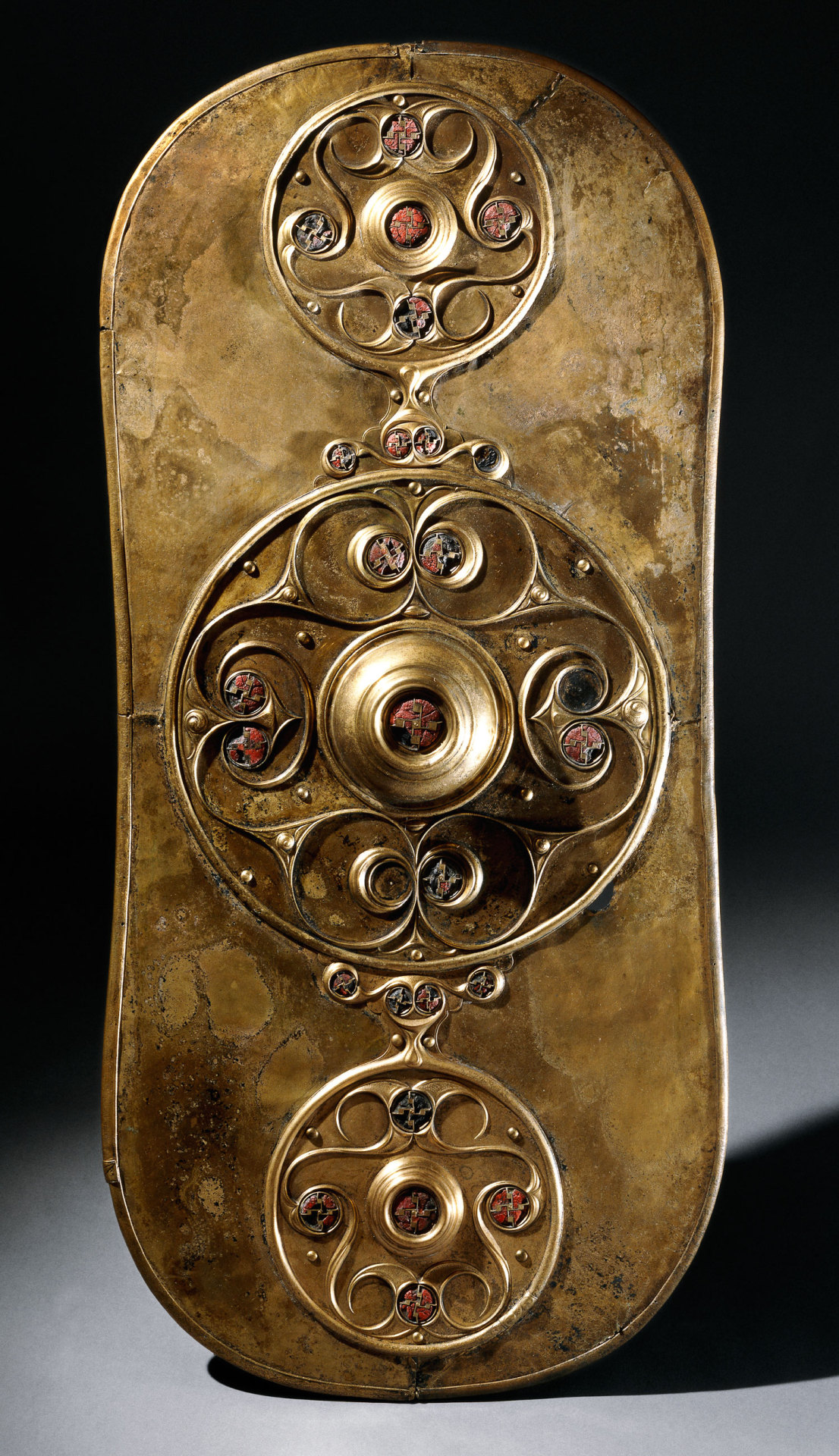
The Battersea shield

image


This magnificent shield was found in the River Thames in 1857, where Battersea Bridge stands today. It dates to the Iron Age, between 350 and 50 BC. The Battersea shield is not actually a complete shield, but only the facing – a metal cover that was attached to the front of wooden shield.
The Battersea shield does not show signs of having been damaged in combat, but this does not necessarily mean that it was not used in warfare. Flamboyant display seems to have been an important part of Iron Age battles, and both weapons and armour are often highly decorative. This decoration is sometimes hidden. Even the handle of the Battersea shield was very ornate. Perhaps the swirling designs were believed to hold magical or protective properties which empowered the warriors who fought with these objects. The highly polished bronze and glinting red glass on the shield would certainly have made for a great spectacle. Ultimately, though, it was thrown or placed in the River Thames, where many weapons were offered as sacrifices in the Bronze and Iron Ages.

image
Iron Age shields are not commonly found. Those shields excavated from Iron Age burials were made of wood, sometimes covered with leather. They have very few metal parts. The Battersea shield is made from different parts of sheet bronze, held together with bronze rivets and enclosed in a binding strip. All the rivets are hidden by overlaps between different components where the panels and roundels were originally attached to the organic backing.

image
All of the decoration is concentrated in the three roundels. A high domed boss in the middle of the central roundel is over where the handle was underneath. The La Tène-style decoration is made using the repoussé technique, emphasised with engraving and stippling. The overall design is highlighted with 27 framed studs of red enamel (opaque red glass) in four different sizes, the largest set at the centre of the boss.

original information: http://britishmuseum.tumblr.com/post/121762286197/the-battersea-shield

More information about collections and available items on sale in: movilla-jewellery.moonfruit.com

Thursday, 27 August 2015

Los Huevos de Fabergé

1 gallina 500Los famosos huevos de Fabergé son en realidad huevos de Pascua. El domingo de resurrección es la mayor fiesta religiosa del año en los países de Europa del este, igual que para nosotros la Navidad. El regalo más típico de esta época del año es el huevo de Pascua porque simboliza larga vida.
Peter Carl Fabergé siguió la trayectoria de su padre que era joyero y concursó con varios diseños en la Exposición Panrusa de Moscú en 1882 donde obtuvo el primer premio. Esto hizo que el Zar Alejandro III se fijara en él y le encargara un año después la realización de un huevo de Pascua para regalárselo a la Zarina María.
coronacion 500Fabergé realizó un huevo con cáscara de platino que contenía dentro uno más pequeño de oro que dentro tenía una gallina también de oro.

Este huevo-joya tuvo tanto éxito que el Zar le encargó realizar uno nuevo cada Pascua. Cuando murió el emperador, su hijo el Zar Nicolás II continuó con la tradición y cada domingo de Pascua le regaló un huevo a su madre y otro distinto a su mujer la Zarina Alejandra.
Este es el Huevo que le regaló a su mujer con motivo de su coronación realizado con esmalte de oro y diamantes engastados que forman el escudo del águila imperial. En su interior hay una replica en oro del carruaje con el que entraron en Moscú.

Los huevos de Fabergé siempre contenían una sorpresa. Para su realización utilizaba el esmalte guilloché, metales como el oro y piedras preciosas. Buscaba representar los colores de la naturaleza simulando flores, plantas, insectos y pájaros siempre con el estilo art nouveau típico de esa época.
Estos son algunos de los que encargó el Zar Nicolás:
3 lirios 500En 1898 le regaló a su mujer el llamado Huevo de los lirios del valle. Está realizado en esmalte rosa con perlas y diamantes con forma de lirios. Al presionar una perla de un lateral, por la parte superior aparecen tres retratos pintados al óleo del Zar y sus dos hijas mayores.


4 cuco 500
El Huevo del cuco es de estilo barroco. Está realizado en esmalte azul-violeta y tiene un reloj en su parte frontal. La peculiaridad de esta pieza es que al presionar un botón de oro que tiene en la parte superior, sale un cuco que mueve sus alas.


5 arbol 500La misma singularidad tiene el Huevo del naranjo que le regaló a su madre. Se trata de una réplica de un árbol en esmalte verde con frutas tropicales que son amatistas, rubíes y diamantes rosas. Al pulsar un botón, las ramas se levantan, suena música y un ruiseñor agita sus alas y abre el pico.


6 san jorge 500Otro muy característico es el Huevo de la Orden de San Jorge que está realizado en esmalte blanco con cuatro retratos del Zar Nicolás.

Fabergé fue nombrado orfebre y joyero de la corte imperial rusa y de otras monarquías europeas. La Revolución Rusa acabó con su joyería y le hizo refugiarse en Suiza hasta su fallecimiento.
De los 54 huevos imperiales de Fabergé sólo se conoce el paradero de 47. La mayoría siguen hoy en día en Rusia. Además de los imperiales, fabricó otros huevos conocidos por el nombre de los Huevos no imperiales para diversas personalidades de la época como Alfred Nobel, los duques de Marlborough o los banqueros Rothschild.
La realización de huevos de Pascua decorados es un oficio muy antiguo en Rusia pero fue Fabergé quien los transformó en un trabajo de orfebrería excepcional convirtiéndolos en joyas intemporales.

 Fuente original: http://blog.hola.com/nosvamosdejoyas/2013/11/la-curiosa-historia-de-los-huevos-imperiales-faberge.html

More information about collections and available items on sale in: movilla-jewellery.moonfruit.com

Wednesday, 5 August 2015

Por qué los relojes siempre han tenido tanto que ver con los aviones


17 de diciembre de 1903, a las 0:35 de la mañana. Es la fecha y la hora exactas en que comenzaba una nueva era para el hombre: la era de la aeronáutica. Todo ocurría en la colina de Kill Devil, en la localidad de Kitty Hawk, en Carolina del Norte. Allí, los hermanos Wright veían realizado uno de sus sueños: volar.


Versión moderna de Breitling Transocean Chronograph Unitime, que la marca lanzó en los años cincuenta para los pilotos comerciales
Llevaban tiempo investigando sobre cómo podían fabricar una máquina voladora, dotada de motor, con la que el hombre pudiese surcar el cielo, y lo consiguieron. Pilotado por Orville Wright, construido junto a su hermano Wilbur y bautizado comoFlyer, la máquina voladora realizó esa mañana cuatro vuelos.
En el primero de ellos se mantuvo en el aire doce segundos, en los que consiguió recorrer una distancia de 36,5 metros. Fue el primer vuelo controlado, propulsado y pilotado de la historia. Los hermanos Wright continuaron desde entonces con sus trabajos, los cuales obtuvieron nuevos resultados y alumbraron otros ingenios voladores, como el Flyer II de 1904 ó el Flyer III de 1905.


Una actualización de Longines del reloj de ángulo horario de Charles Lindbergh
Otro pionero de la aviación es el brasileño Alberto Santos Dumont, gran amigo de Louis Cartier: el joyero francés diseñó en 1904 el modelo de pulsera que lleva su nombre, Santos, para que pudiese leer la hora en pleno vuelo. En Brasil está considerado como el padre de la aviación, pasando a la historia por ser el primer hombre en llevar a cabo el primer vuelo-salto, atestiguado oficialmente, de un avión propulsado y tripulado en Europa. El 12 de noviembre de 1906, en el Bois de Boulogne, logró recorrer una distancia de 220 metros en 21,2 segundos con su propio aeroplano, el 14 Bis.


El Zenith Pilot Montre D'Aéronef Type 20 GMT 1903 está inspirado en los relojes del servicio postal aéreo francés de 1939
Otra fecha importante en la era aeronáutica es el 25 de julio de 1909, día en el que el francés Louis Blériot se convirtió en el primer hombre en cruzar el Canal de La Mancha en aeroplano. Blériot sería posteriormente el nombre de algunos aviones, cosa que también ocurriría con el nombre Breguet.
Louis Breguet fue uno de los principales innovadores de la aviación francesa, desarrollando entre otros, el biplano Breguet I en 1909. El 23 de marzo de 1911 hacía historia transportando a once personas sobre una distancia de cinco kilómetros a los mandos de un voluminoso monoplano en parasol de diseño propio.


Oris Big Crown Flight Timer, una edición limitada para conmemorar el 60 aniversario del final de la Segunda Guerra Mundial
Años más tarde, durante la Primera Guerra Mundial, se crean por vez primera las fuerzas aéreas en ambos bandos, lo que supone el comienzo de la aviación militar. Durante estos años comienzan a popularizarse el reloj de pulsera entre los soldados y los pilotos, que resulta ser más práctico que el reloj de bolsillo, tanto en tierra como en el aire.
Otra figura importante del mundo de la aviación (y asociada directamente a la relojería), es el capitán Charles Lindbergh, quien a los mandos del Spirit of St. Louis lleva a cabo la primera travesía del Atlántico Norte, en solitario y sin escalas. Realizó su hazaña los días 20 y 21 de mayo de 1297 y cubrió la distancia de 5.780 kilómetros que une Long Island (NY) con Le Bourget (París).


Reedición de IWC de su modelo Gran Aviador en 2006
Años más tarde, en 1939, daba comienzo la Segunda Guerra Mundial. Ya en estos años era más común el reloj de pulsera y, en concreto para los pilotos civiles y militares, se trataba de un elemento completamente indispensable para realizar con eficacia su labor.
Con el paso de los años, el hombre ha ido consiguiendo otros logros aéreos, incluso otro hecho de gran relevancia histórica que no habría sido posible sin la ayuda de la aeronáutica: la llegada a la luna el 21 de julio de 1969.

Hijos de la aviación


Uno de los modelos de Omega Speedmaster que acompañó al hombre a la luna
Los relojes han estado presentes en el nacimiento de la aviación. Desde que acompañaron a los hermanos Wright aquella mañana de 1903 se han convertido en un instrumento indispensable para realizar cálculos y mediciones en la navegación aérea. Muchas firmas de relojería han fabricado piezas específicas destinadas a los pilotos o relacionadas directamente con la aviación. Son muchas y eso hace imposible plasmar todas ellas en este espacio, pero citaremos algunas:
Lange & Söhne: la casa de Glashütte realizó piezas de gran calidad para la aviación, siendo uno de los proveedores de Lutwaffe alemana durante la Segunda Guerra Mundial. Utilizó calibres de bolsillo (Lange 48/1, por ejemplo), para adaptarlos a relojes de pulsera con 55 milímetros de diámetro. Aunque enormes, la legibilidad, además de la precisión, era indispensable en las alturas.
Bell & Ross: desde su nacimiento, sus relojes han estado inspirados en la aviación, de la que se ha inspirado para realizar piezas de gran visibilidad, sencillas, precisas, funcionales y fiables.
Breguet: Louis Breguet fue uno de los fundadores de Air France en 1933. Su modelo Type XX fue creado en los 50 especialmente para la aviación francesa.
Breitling: siempre relacionada con la aviación, son famosos sus relojes con regla de cálculo. Posee ediciones limitadas que homenajean hitos de la aeronáutica (como a los Wright), líneas con nombres como Navitimer, Airbourne o Cosmonaute, diversas patrullas aéreas como los Fighters, Eagles o los Wingwalkers, y hasta un avión, Superconstellation.
IWC: una de las grandes pioneras en este campo desde su Mark IX. Posee una colección completa de relojes de aviación y también sirvió a la Lutwaffe. Gran Aviador, Spitfire... Jaeger-LeCoultre: fue proveedor de la aviación francesa por la precisión de sus contadores de vuelo. Destaca su Chronofight.
Longines: su colección Avigation, que proviene de la unión de las palabras aviation y navigation, designa un término de navegación aérea que a principio de los años 20 creó el militar americano Philip Weems (Longines Weems Second-Setting Watch). También crearon, junto a Charles Lindbergh, el reloj que lleva su nombre y con el que realizó su hazaña del Atlántico Norte.
Omega: hizo piezas para la R.A.F. en 1914. Y qué decir de su Speedmaster y la Luna...
Oris: hay que mencionar sus modelos Big Crown, que fueron suministrados a la aviación aliada en la Segunda Guerra Mundial.
Otras firmas a destacar son Alpina, Blancpain, Chronoswiss, Ebel, Fortis, Hamilton, Hanhart, Glashütte, Glycine, Laco, Revue Thommen, Stowa, Tutima, Wempe o Zenith, pero como anunciamos al principio, no habría suficiente espacio ni en todo el número.
Articulo original: http://elpais.com/elpais/2015/01/08/icon/1420718418_580349.html

More information about collections and available items on sale in: movilla-jewellery.moonfruit.com

Sunday, 19 July 2015

Modern ‘Fabergé Egg’ Containing Lunar Bible Fragment on auction

Photo credit: Anthony DeMarco
At Bonhams Space History Sale they discovered something  that was interesting and unusual.

It is being a called a Fabergé Egg but it bears no resemblance to the 50 bejeweled Imperial Easter eggs created from approximately 1885 to 1917 by Peter Carl Fabergé for the Russian tsars Alexander III and Nicholas II.
Cassandra Hatton, Bonhams director of History of Science & Technology, explains that the egg was made by a company that owned the Fabergé name at the time.

Photo credit: Anthony DeMarco


From as early as 1937 until 2007, the Fabergé brand was bought and sold and under disputed ownership by several entities, including the Fabergé family. From 1964 till 1984 the company was known as Faberge Inc., owned by George Barrie. This is the most likely source of the modern egg.
So it isn't a Fabergé Egg. It is a jeweled egg made by Fabergé.
What’s encased in the silver and gilt metal 3.5 x 1.5 inch egg is what the auction house is selling: A microfiche version of a 50-page fragment from the King James Bible, taken to the moon as part of the Apollo 14 mission. 
Photo credit: Anthony DeMarco


It was a part of 100 complete copies of the Bible in microfiche that were taken on the nine-day lunar mission that launched January 31, 1971. However, for some reason only 32 fragments have been officially flight-certified to date, making this “an extremely rare and important religious artifact,” according to the auction house.

How this particular 50-page fragment became encased in what is being called a Fabergé egg is unclear.
This Faberge Inc. modern egg is decorated in gilt bows and swags with three agate cabochons embedded in the base, topped with an amethyst, according to the auction house. The base is felt lined and stenciled with the name “Fabergé” in gilt. The egg opens to display the microfiche Bible fragment in a transparent plastic square on a white pearl background. It is housed in a velvet box with the Fabergé name and with a brass plaque reading, “Apollo 14 Lunar Surface Bible Text Fragment – 50 Pages,” with a provenance letter signed by Apollo 14 astronaut Edgar Mitchell and James W. Stout.

Photo credit: Anthony DeMarco


Mitchell was entrusted with taking the bibles to the moon on the Lunar Module. Rev. Stout founded the Apollo Prayer League in1967 with the goal of landing the first Bibles on the Moon. He succeeded. 


 The estimate for the Bible and jeweled container is $10,000 - $15,000.

Fuente original: http://jewelrynewsnetwork.blogspot.com.es/2015/04/modern-day-faberge-egg-containing-lunar.html

More information about collections and available items on sale in: movilla-jewellery.moonfruit.com

Thursday, 25 June 2015

La talla Si que importa...

En este post podreís conocer, con palabras sencillas y sin tecnicismos, el mundo de las tallas del diamante.

De la talla de un diamante depende su brillo y resplandor. Una buena talla consigue sacar el máximo destello que puede alcanzar esa piedra y esta es precisamente la difícil tarea del lapidario: conseguir que el diamante refleje el máximo de luz.
Si un diamante está bien tallado, la luz entra por la parte superior y se refleja saliendo de nuevo hacia arriba. La mejor talla se consigue cuando las proporciones entre las diferentes partes del diamante son las adecuadas, si estas proporciones no son buenas, el diamante no brillará igual o se verá más apagado.
Estas son las 9 tallas más conocidas:
1 brillante 500La talla brillante es la más común y la más solicitada. Tiene forma redonda y 57 facetas. Es la que más destaca el peso del diamante. No se debe confundir la talla, que es brillante, con la gema, que es diamante.


2 esmeralda 500La talla esmeralda tiene forma rectangular y 48 o 50 facetas. Debe su nombre a la forma clásica en la que se cortan las esmeraldas. Tiene cuatro lados y es alargada.


3 corazon 500La talla corazón tiene 59 facetas y es en realidad un brillante con forma de corazón.


4 princesa 500La talla princesa tiene forma cuadrada con 76 facetas. Podríamos decir que es una mezcla entre la talla carré y la talla brillante. Es muy luminosa.


5 pera 500La talla pera tiene forma de lágrima. La parte redondeada es la más brillante.


6 marquesa 500
La talla marquesa es alargada y termina en punta en ambos extremos. Tiene 58 facetas y es muy luminosa en el centro y menos en las puntas.


7 baguette 500


La talla baguette tiene forma estrecha y alargada como el pan francés al que debe su nombre.


8 oval 500La talla oval tiene forma de elipse y 56 facetas. Se basa en la configuración tradicional del brillante.
Existen otras tallas llamadas Fancy o Fantasía. Todas estas tallas se realizan también en otras gemas como zafiros, rubíes, esmeraldas, aguamarinas, turmalinas, amatistas, etc.
La calidad de un diamante y su precio están determinados además de por la talla, por el color, la pureza y el peso. Los organismos más prestigiosos para certificar oficialmente un diamante son: la GIA (Gemological Institute of America) y el HRD (Hoge Raad voor Diamant) se rige por el Consejo Superior del Diamante de Amberes. En España podéis recurrir al IGE (Instituto Gemológico Español) o a GEMACYT que sigue las normas del HRD.

fuente original: http://blog.hola.com/nosvamosdejoyas/2013/12/la-talla-si-importa.html

More information about collections and available items on sale in: movilla-jewellery.moonfruit.com

Tuesday, 2 June 2015

Museo de Artes Decorativas de Madrid "plata, deseo y Realidad"

Siempre que viajo a alguna ciudad europea procuro informarme de los eventos relacionados con el mundo de la joyería y las artes decorativas. No son tantos como los que uno quisiera, pero ciertamente son muchos mas de los que uno se pudiera imaginar. Prácticamente cada semana hay algo interesante en las principales capitales europeas, y aunque no haya nada específico, siempre queda revisitar los principales museos de la ciudad y sus clásicas piezas. Durante el mes de febrero tuve oportunidad de asistir a una exposición que se realizó en Madrid en el museo de Artes decorativas. Ocasionalmente, además de la exposición de puede acceder a alguna de las charlas, por lo que la visita es mucho más clarificadora y educativa. 


Antes de nada comentar que el museo es un pequeño palacete situado a escasos metros del parque del Retiro y cuya existencia desconocía hasta el mismo día del evento. 

Lo cierto es que es una asociación de amantes de las artes decorativas que se reúnen para organizar determinadas exposiciones de artículos contenidos en sus fondos y de los cuales los curadores oficiales se encuentran investigando a diario para descubrir sus misterios y secretos. Y es ahí cuando se organizan estas pequeñas charlas en las que uno descubre infinidad de datos desconocidos e iluminadores. 

En concreto esta charla era sobre los orígenes y evolución de la platería en España, y para mi, que he estado formándome principalmente en platería Inglesa, supone un descubrimiento muy interesante. 

Fruto de esas informaciones nuevas adquiridas fueron algunos de los artículos antiguos del blog, después de investigar historias como la de los visigodos, que eran un pueblo conquistador y fuertemente relacionado con la forja y orfebrería, y cuya costumbre de "reciclar" las joyas de los pueblos conquistados nos deja en muchos casos sin evidencias de joyería de pueblos conquistados y en otros muchos casos con mezclas de estilos y collages de joyas convertidas en otros objetos. Esa idea me gustó mucho ya que coincide en cierto modo con lo que yo hago y supone darle una nueva vida a un objeto antiguo, un nuevo renacer desde el ostracismo hasta la creación de una nueva pieza lista para ser disfrutada de nuevo. 

También descubrí con gusto los libros de exámenes de los plateros, donde se recogen los dibujos que estos realizaban para pasar de aprendiz y que son verdaderas obras de arte. dibujos que luego sus jefes orfebres utilizaban de "inspiración" para sus propias creaciones, y de los que en alguno de los casos se conservan ambos dibujo y pieza final. Este tema de los libros de exámenes de plateros es algo que me gustaría investigar más a fondo y puede que de origen a otra entrada de este blog. 


De momento os dejo algunas fotos tomadas de los objetos expuestos en sus salas durante la exposición. 

More information about collections and available items on sale in: movilla-jewellery.moonfruit.com

MAN (Museo Arqueológico Nacional)

Aprovechando mi estancia en la Capital de España tenía muchas ganas de volver a visitar el Museo Arqueológico Nacional. Desde que era niño no había vuelto a visitarlo y después de la gran reforma que han sufrido sus interiores, era una de las espinitas que tenía clavada, el no haberme pasado por aquí a descubrirlo de nuevo. 


Y así por solo 3€ me adentré en el museo en uno de los días más calurosos que ha visto Madrid en el mes de Mayo. Se agradece el aire acondicionado y la amplitud de las estancias que invitan a quedarte el resto del día hasta que hayas recorrido todas las vitrinas del museo. 

Lo cierto es que mi interés actualmente se centra en los artículos relacionados con la joyería y orfebrería, por lo que en un principio pensé que mi visita se limitaría a la planta tercera, donde desde la edad media se puede admirar un montón de creaciones de excelente factura. 


Grave error dejar las plantas de abajo para un vistazo final, donde se encuentran también una cantidad importante de joyas desde el mundo prehistórico, mucho más misteriosas e inspiradoras. Quizás para una próxima visita. 

Y es que muchas veces no son sólamente otras joyas las que te inspiran para hacer una nueva creación, sino formas y dibujos en cuadros, tallados en piedras misteriosas y relieves que surgen de cuadros o jambas de puertas y ventanas. Todo es inspirador, y como tal encontré varias piedras ya casi a la salida, con glifos y dibujos circulares que los investigadores aún no han sabido dar explicación certera y que seguramente utilizaré en algún momento para inspirar un colgante. 

Otra figura inspiradora es una estatuilla de origen precolombino que tiene en la mano dos espirales que se enroscan en direcciones opuestas y que perfectamente pueden representar un símbolo de poder o de culto. Algunas piezas serán pronto visibles en la tienda online junto con el origen de las mismas. 


Aquí os dejo las fotos de las piedras, junto con otras de joyas absolutamente fantásticas realizadas en distintas épocas. 

More information about collections and available items on sale in: movilla-jewellery.moonfruit.com